Sabah has 1 doctor for every 1,283 people.
The national target is 1 per 400. Kuala Lumpur sits at 1 per 178.
Same country. Same national healthcare system. 7× difference in access.
When I saw that number, I didn't write an opinion piece. I ran DMAIC on it — with AI.
The Investigation
This is a live DMAIC investigation conducted using ZenPMAI, an AI-assisted DMAIC system I am building. The methodology is real. The findings are data-driven.
Full disclosure upfront: Some figures are estimates. The DOE was modelled using a Passive Factorial Screening Study (PFSS) — not field-collected data. Where data gaps exist, I have flagged them explicitly. This is a rigorous analysis with disclosed limitations — not a polished policy report.
Phase 1 — Define: Is the Shortage Real?
Problem Statement: Sabah has only 2,884 doctors serving 3.7 million people — 68% below the 1:400 benchmark. Actual ratio: 1:1,283.
CTQ (Critical to Quality): ≥1 doctor per 400 people at district level.
Current state: FAILING.
The SIPOC mapping revealed where the pipeline breaks:
| Process Step | Owner | Critical Loss |
|---|---|---|
| Secondary school | MOE | Fewer science stream schools in rural Sabah |
| Matriculation | KPM | Sabah student share of national quota unclear |
| Medical school | Universities + MMC | Graduates dropped 49% (6,147 in 2017 → 3,131 in 2022) |
| Housemanship | MOH/KKM | 5,000 slots available — only 529 filled in East Malaysia (89% loss) |
| MO deployment — Sabah | JPA/MOH | 2,884 deployed vs ~9,000 needed |
The 89% loss at the Housemanship stage is the most striking number in the dataset. It is sourced from MOH Annual Report 2023, Table 4.2 — not an assumption.
Is/Is Not: The shortage is a public sector, Sabah-specific, deployment and retention failure — not a Malaysia-wide graduate supply problem, and not a private sector issue.
Phase 2 — Measure: How Bad Is It?
Value Stream Map — Current State
Five ministries own a stage in the pipeline. All five have to work for a doctor to reach Sabah.
| # | Process | Owner | Critical Loss |
|---|---|---|---|
| 1 | Secondary school | MOE | Fewer science stream schools in rural Sabah |
| 2 | Matriculation | KPM / private | Sabah student share of national quota unclear |
| 3 | Medical school | Universities + MMC | −49% graduates (6,147 in 2017 → 3,131 in 2022) |
| 4 | Housemanship | MOH/KKM | 5,000 slots — only 529 filled in East Malaysia (89% loss) |
| 5 | Medical Officer — Sabah | JPA / MOH / State | 3,500 resign/yr · 68% deployment gap · CTQ FAILING |
Multi-ministry insight: No single ministry owns the problem. MOE, KPM, universities, MMC, MOH, and JPA each control a critical step. The pipeline loses doctors at every handoff — most catastrophically at Step 4.
Process Capability: Using 25 Sabah districts as the measurement unit:
| Category | Districts | Likely Ratio | Meets CTQ? |
|---|---|---|---|
| KK metro (Kota Kinabalu, Penampang) | 2 | 1:300–400 | Likely ✓ |
| Secondary urban (Sandakan, Tawau, Keningau) | 4 | 1:500–800 | Borderline |
| Semi-urban | 5 | 1:900–1,400 | ✗ Failing |
| Rural & interior | 14 | 1:1,500–3,000+ | ✗ Severely failing |
Process Sigma: ~0.2–0.4σ. A capable process requires ≥4σ. The system is not close.
MSA note: The official 1:1,283 figure likely understates the shortage. Non-clinical and contract doctors are included in the numerator. An undocumented population of 800K–1.2M is excluded from the denominator. Adjusting for undocumented population alone worsens the ratio to approximately 1:1,566.
Key finding from Measure: The state average masks a bimodal distribution. KK urban is near target. Interior districts are at 3–8× worse. Aggregates hide the crisis.
Phase 3 — Analyze: What Is Actually Driving This?
A Cause & Effect Matrix scored 10 KPIVs against 5 KPOVs. Top 4 factors — all retention and deployment levers, not supply levers:
| Rank | Factor | C&E Score |
|---|---|---|
| 1 | On-call allowance (RM/call) | 264 |
| 2 | % Housemanship posts in East Malaysia | 234 |
| 3 | MO starting salary UD41 | 190 |
| 4 | SpR specialist training spots | 183 |
The shortage is primarily a retention and deployment failure — not a graduate supply failure.
Fishbone — Ishikawa Cause & Effect Diagram
The Ishikawa diagram maps all contributing causes to the effect: Insufficient doctors in Sabah — CTQ FAILING (1:1,283 vs 1:400).
★ marks the vital few — the causes that drive the most variance.
| Rank | Root Cause | Category | Owner |
|---|---|---|---|
| ★ 1 | On-call allowance frozen at RM200 since 2012 | Policy & Method | MOH / MOF |
| ★ 2 | Housemanship posts 89% Peninsula-heavy — East Malaysia under-allocated | Process | MOH / JPA |
| ★ 3 | Govt salary UD41 uncompetitive vs private sector | Policy & Method | JPA / MOF |
| ★ 4 | SpR specialist training concentrated in KL — doctors must relocate to advance | People (Retention) | MOH / Universities |
| — | MMC registration delays | Process | MMC |
| — | JPA bond terms perceived as punitive | Policy | JPA |
| — | Rural infrastructure and amenities gap | Environment | State / KPKT |
| — | Brain drain to Singapore and private sector | People | Systemic |
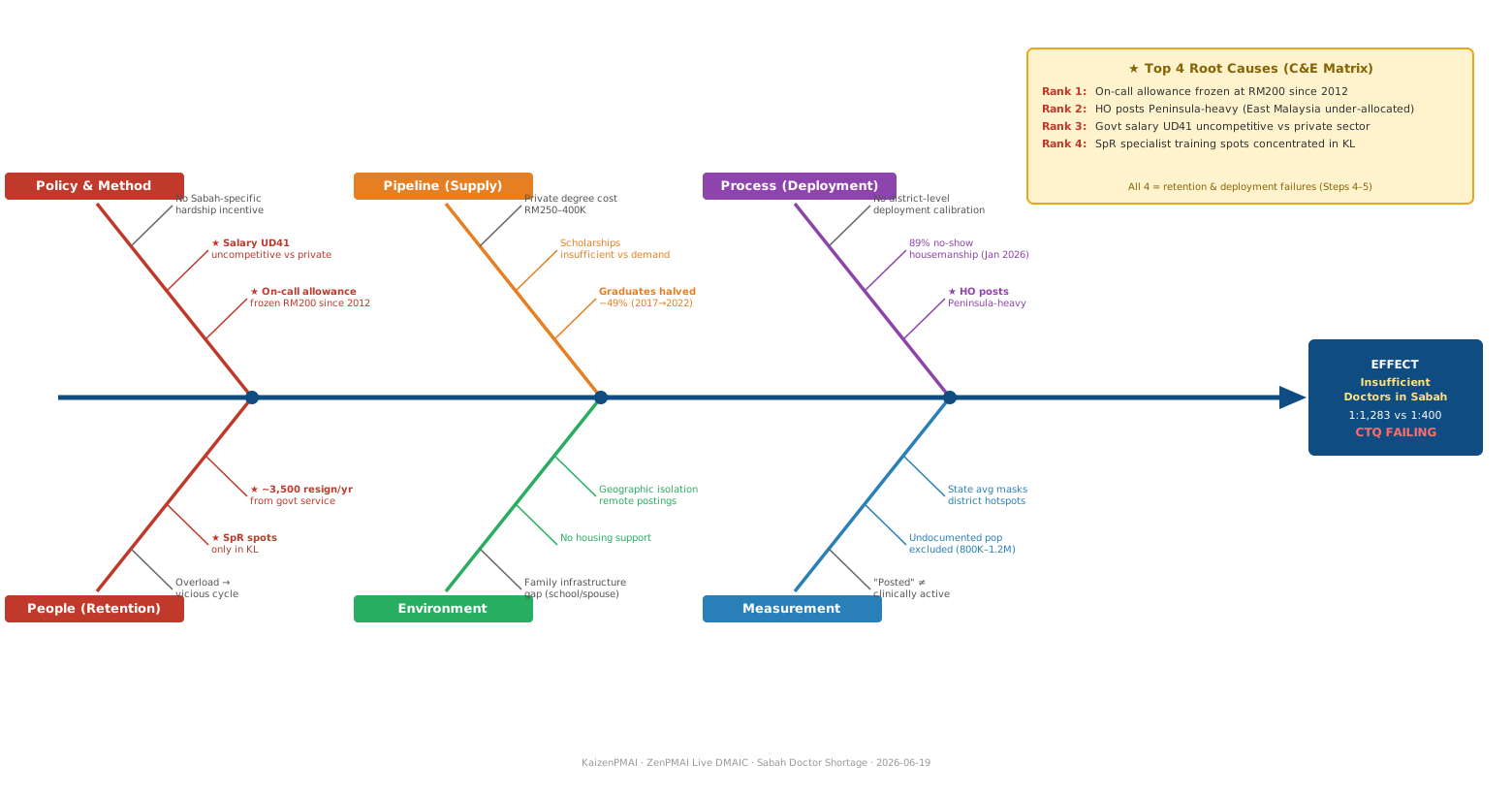 Fishbone Ishikawa Diagram — Sabah Doctor Shortage
Reading the fishbone: The ★ causes are not the loudest in public debate. On-call pay and salary get the most political airtime — but the diagram shows they are symptoms of a deeper structural misalignment. The pipeline was never designed to serve East Malaysia equitably.
Screening DOE — PFSS
A 2⁴ Passive Factorial Screening Study tested all 16 combinations of 4 reform levers (A = on-call allowance, B = housemanship reallocation, C = salary, D = SpR access).
Result: B + D = 84% of the variance.
| Rank | Factor | Effect | % Variance | Verdict |
|---|---|---|---|---|
| 1 | B — Housemanship reallocation | +12.44 | 48.8% | Vital Few |
| 2 | D — SpR specialist access | +10.56 | 35.2% | Vital Few |
| 3 | C — Salary | +5.31 | 8.9% | Supporting |
| 4 | A — On-call allowance | +2.44 | 1.9% | Hygiene |
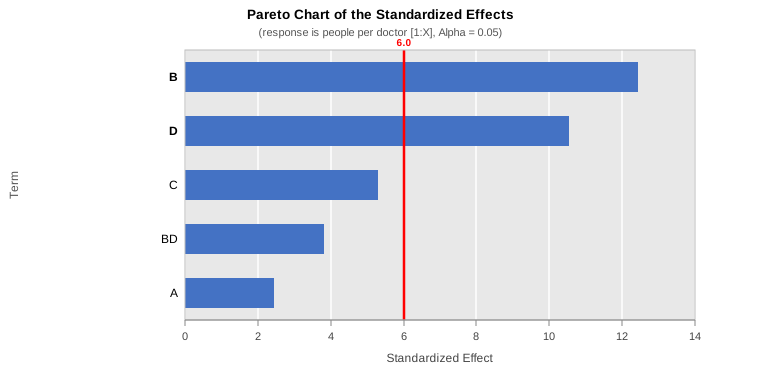 Pareto Chart of Standardized Effects
B and D exceed the red reference line (α = 0.05) — statistically significant. A = on-call allowance · B = housemanship reallocation · C = salary · D = SpR access · BD = B×D interaction
Minimum viable intervention: B High + D High (Run 11) → 1:333 people per doctor — CTQ MET ✓
Run 8 (on-call + housemanship + salary, no SpR) → 1:408 — misses CTQ.
D is structurally non-negotiable.
What This Means
- On-call allowance is the most politically discussed lever. Lowest analytical impact. Legitimate grievance — not a structural driver.
- Salary matters — 13 years of frozen wages confirm it. But salary reform alone does not cross CTQ. It is supporting, not vital.
- Housemanship reallocation is the primary structural lever. 89% of posts Peninsula-heavy. This is a policy decision that can be changed.
- SpR access is the career-progression lock. Doctors go to Sabah but cannot build a specialist career there. Fix B without fixing D = revolving door. The BD interaction (+3.81) confirms they must be deployed as a bundle.
The Answer
Root cause: Housemanship deployment policy is 89% Peninsula-heavy, and specialist training (SpR) is concentrated in KL. Deploy doctors to East Malaysia AND build local career progression. Run 11 confirms: fix both, and Sabah crosses the 1:400 target.
This is not a salary problem. Not a funding problem. It is a structural deployment and career progression problem — and that is exactly what DMAIC is built to find.
On the Methodology
This investigation was conducted using DMAIC with AI assistance. The PFSS is a ZenPMAI adaptation of physical DOE for secondary-data policy investigations — same analytical framework, adapted to available data. Factor levels, response values, and interaction estimates are grounded in MOH data and domain knowledge, with all assumptions explicitly disclosed.
The Improve and Control phases are pending — this report covers Define through Analyze.
About ZenPMAI
ZenPMAI is an AI-assisted DMAIC system I am building — a multi-agent platform that runs structured root cause analysis alongside human project leaders. The investigation above was conducted using ZenPMAI in its current form.
The interface you saw in the video? That is the vision for where it is going.
Follow for launch updates.
*Haqeem Zulkiflee is a PfMP / PgMP / PMP / MBB