By Haqeem Zulkiflee
PfMP / PgMP / PMP / MBB
If you ask the average Malaysian about graduate employability, you will usually hear a familiar diagnosis focused entirely on graduate readiness: "Graduates lack soft skills," "Their English is weak," or "They demand unrealistic entry-level salaries."
Look at the official headline economic statistics and the situation appears reassuringly contained: graduate unemployment sits at a modest 3.2%, closely mirroring national full-employment levels.
However, when we apply Lean Six Sigma discipline to establish a rigorous operational definition of a process "defect"—counting any graduate who is unemployed, working outside their field of study, or trapped in a job below their qualification level—the operational reality transforms completely.
The primary structural defect in Malaysia's graduate pipeline is not headline unemployment. It is skill-related underemployment, which stands at 32.2% (Department of Statistics Malaysia, 2024)—over 1.6 million degree holders actively employed in positions that do not require tertiary qualifications. This 32.2% captures the under-levelled slice specifically: graduates working beneath their qualification. It is the dominant, measurable component of the broader defect and the focus of this cost analysis; the unemployed and field-mismatched populations sit on top of it.
As part of an ongoing DMAIC (Define-Measure-Analyze-Improve-Control) public policy case study, I performed a forensic Cost of Poor Quality (COPQ) evaluation to answer a vital question: What is the quantifiable economic cost of this 32.2% mismatch to the nation?
By replacing anecdotal speculation with verified data from DOSM, LHDN, and the World Bank, the findings demand a fundamental reframing of national policy priorities.
A decade of structural underemployment — not a one-year blip
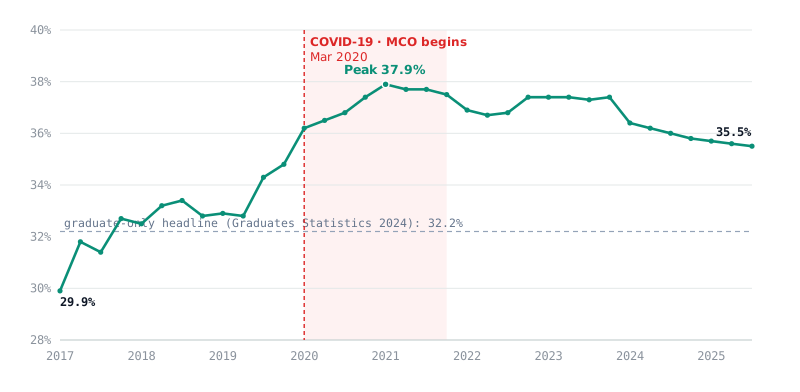 Line chart of Malaysia's tertiary skill-related underemployment rate, quarterly, 2017 Q1 to 2025 Q3 (DOSM Labour Force Survey). The series is broadly flat before 2020, jumps sharply during the COVID-19 period to a 37.9% peak in 2021 Q1, and eases only slowly to 35.5% by 2025.
Read the definition, not just the line. This series counts all tertiary-educated persons (diploma + degree) working in semi-skilled or low-skilled jobs, so it sits a few points above the 32.2% graduate-only headline this case is built on — both are DOSM figures, they simply measure slightly different populations. The story is the shape: broadly flat pre-2020, a sharp COVID-era jump to a 37.9% peak (2021 Q1), and only a slow easing since. Underemployment is structural, not a pandemic blip. Source: Department of Statistics Malaysia (DOSM), Labour Force Survey — "Skills-Related Underemployment by Age" (dataset lfs_qtr_sru_age, open.dosm.gov.my), overall tertiary series, 2017 Q1–2025 Q3. Retrieved 2026-07-01.
1. The Hard Fiscal Loss: RM2.24 Billion in Direct Lost Tax Revenue
Forensic COPQ methodology requires an explicit distinction between direct financial leakage from government coffers and macroeconomic capacity gaps.
Standard tax modeling often assumes zero or minimal tax reliefs, inflating revenue claims. However, applying a realistic, maximum-relief package (~RM19,000 across Basic, EPF, SOCSO, Lifestyle, and Medical reliefs per LHDN YA2024 tax schedules), an underemployed graduate earning SPM-level proxy wages pays approximately RM79/year in income tax, compared to RM1,481/year paid by a properly matched graduate.
This individual tax differential represents a real, direct fiscal loss to the Malaysian government of RM2.24 billion annually in uncollected tax revenue.
2. Soft Value Losses: RM56 Billion in National Economic Capacity Drag
Beyond direct fiscal revenues, the broader systemic impact represents what quality engineering classifies as "soft value losses"—the structural destruction of national capability, productive efficiency, and industrial innovation.
| COPQ Component | Per Person Metric | National Aggregate (1.6M Grads) | Loss Classification |
|---|---|---|---|
| Lost Income Tax Revenue | RM 1,402 / yr | RM 2.24B / yr | Real Hard Fiscal Loss (Government) |
| National Productivity & Capacity Gap | RM 33,600 – RM 37,200 / yr | RM 53.8B – RM 59.5B / yr | Soft Loss (Creativity/Efficiency) |
| Study Time (Foregone Earnings) | RM 56,000 – RM 112,000 | RM 90B – RM 179B | Sunk Capacity Investment |
| Study Fees (Student + Govt) | RM 21,000 – RM 77,000 | RM 34B – RM 123B | Sunk Financial Investment |
In April 2026, the World Bank (Malaysia Economic Monitor) documented that Malaysian graduates in mismatched roles suffer a wage penalty of up to 49.3% compared to matched peers. Aggregated across 1.6 million degree holders, this represents RM56 billion to RM62 billion annually in unfulfilled national productivity, operational efficiency, and creative potential. To be technically disciplined: this RM56B figure does not represent direct out-of-pocket cash lost by individuals or government spending, but rather the immense unfulfilled economic capacity of the nation's human capital stock.
- Skills Atrophy ("Career Scarring"): Longitudinal data from the Khazanah Research Institute (KRI, Shifting Tides 2024) indicates that over one-third of mismatched graduates remain permanently trapped in low-skilled roles.
- Accelerated Brain Drain: High-performing graduates unable to secure commensurate domestic employment increasingly seek opportunities in regional economic hubs, exporting 100% of state-subsidized human capital ROI.
- Middle-Income Trap Feedback Loop: An abundance of overqualified graduate labor reduces employer incentives to automate and move up the value chain. As DOSM data shows, only about 1 in 4 jobs and 1 in 4 unfilled vacancies are high-skilled (Labour Market Review, Q1 2025).
- Future Social Safety Net Liabilities: Suppressed graduate wages reduce statutory EPF accumulations by approximately RM8,400/year per graduate—accumulating a national RM13.4 billion annual deficit in retirement wealth creation.
3. Structural Supply Chain Mapping (The SIPOC Perspective)
A defective graduate output is not created overnight at the university graduation stage. Applying Six Sigma Value Stream logic, I map the end-to-end talent transformation pipeline:
Parents/Families → Primary School → Secondary School → Pre-University → University → Job Market
     Tier 0           Tier 1           Tier 2            Tier 3          Tier 4       Tier 5
Quality defects accumulate progressively across every tier. Field selection at Tier 3 sets the structural trajectory; institutional curriculum alignment at Tier 4 determines technical readiness; labour market structure at Tier 5 dictates whether commensurate roles exist to absorb graduates.
4. Active Policy Initiatives and the Strategic Benchmark Gap
It is vital to recognize that Malaysian policy makers are actively implementing constructive interventions to strengthen graduate outcomes. Landmark initiatives include:
- PROTÉGÉ: Operating under KUSKOP (launched in 2019 as the enhanced successor to SL1M), this initiative provides structured soft skills training, industry placements, and living allowances.
- 2u2i Work-Based Learning Programme: Spearheaded by MOHE under the Higher Education Blueprint, allowing students to split time between academic study and practical industry immersion.
- CEO@Faculty Programme: A signature MOHE initiative pairing corporate leaders (from Petronas, Maybank, Huawei) directly with public universities to align curricula with market needs.
However, an analysis of macro public policy frameworks reveals a critical strategic benchmark gap. Based on publicly available strategic planning documents—such as PSKG 2026–2030 and RPTM 2026–2035—an explicit, numeric target for reducing skill-related underemployment could not be verified or found within published target frameworks.
Instead, official performance reporting continues to rely primarily on headline indicators: a ~92.5% Graduate Employment Rate (MOHE Graduate Tracer Study) and 3.2% headline graduate unemployment (DOSM Labour Force Survey). These are two different instruments measuring two different populations — they were never meant to be complements — yet both share the same blind spot: each counts an underemployed degree holder working as a delivery rider or retail cashier as a complete operational "success" (employed). The 32.2% structural underemployment defect sits inside both green numbers and remains largely unquantified at the macro goal level.
5. Immediate Actionable Steps (While Full DMAIC Analysis Is Underway)
While a comprehensive Lean Six Sigma DMAIC analysis is currently underway to forensically isolate and verify root cause interactions across all pipeline stages (the upcoming Analyze phase), several immediate, evidence-backed strategic steps can be implemented by policy leaders and higher education institutions:
- Quantify Macro Underemployment Targets: Formally incorporate explicit numeric targets for reducing skill-related underemployment into national higher education and human capital dashboards.
- Drive Demand-Side Economic Upgrading: Coordinate higher education expansion directly with industrial masterplans (NIMP 2030) to incentivize high-skilled job creation.
- Provide Transparent Field-of-Study ROI Data: Publish transparent, field-specific mismatch and starting salary data for prospective students and parents prior to university enrollment.
This article is part of the ongoing ZenPMAI open research series applying industrial process rigour to public policy challenges. Full DMAIC Define documentation and underlying analytical datasets are accessible in the ZenPMAI public repository.